
How Tankless Water Heaters Work
Unlike traditional tank water heaters that store and continuously heat 40-80 gallons of water, tankless water heaters heat water on demand as it flows through the unit. When you turn on a hot water faucet, cold water travels through a pipe into the tankless unit where a gas burner or electric element heats the water instantly. The result is a continuous supply of hot water without the standby energy losses associated with storing heated water in a tank.
A tankless water heater contains a flow sensor that detects when water is flowing, a modulating gas valve or electric element that adjusts heat output based on demand, and a heat exchanger that transfers heat to the water. Modern units like the Navien NPE-2 series can modulate their output from as low as 15,000 BTUs up to 199,000 BTUs, adjusting to exactly the amount of heat needed at any given moment. This modulation is what makes tankless units so efficient -- they never burn more fuel than necessary.
For homeowners in Cody and the Big Horn Basin, tankless water heaters represent a significant upgrade in both performance and efficiency. Instead of running out of hot water after back-to-back showers, a properly sized tankless unit delivers hot water for as long as you need it. Whether you are filling a large soaking tub, running the dishwasher while someone showers, or hosting guests who put extra demand on your hot water supply, a tankless system keeps up.
Benefits of Going Tankless
Tankless water heaters offer several compelling advantages over traditional tank-style units, especially for homes in Wyoming where energy costs and harsh winters make efficiency a priority.
Endless Hot Water
The most obvious benefit is unlimited hot water. A tankless unit heats water as it flows, so there is no tank to drain. Whether your household has two people or ten, a properly sized tankless unit delivers hot water continuously without the wait time of reheating a depleted tank.
Energy Savings of 20-30%
Tank water heaters lose heat through the walls of the tank 24 hours a day, even when no one is using hot water. This standby heat loss accounts for a significant portion of your energy bill. Tankless units eliminate standby loss entirely, reducing water heating energy consumption by 20-30% for most households. Over the 15-20 year lifespan of a tankless unit, these savings add up to thousands of dollars.
15-20 Year Lifespan
While a traditional tank water heater lasts 8-12 years, a well-maintained tankless unit lasts 15-20 years or more. The heat exchanger and internal components are designed for long service life, and most parts are individually replaceable rather than requiring full unit replacement.
Space Savings
A tankless water heater mounts on a wall and is roughly the size of a small suitcase. This frees up significant floor space compared to a 50-gallon tank that stands over five feet tall and two feet in diameter. For homes with limited utility space, this is a major advantage.
Reduced Risk of Water Damage
Tank water heaters can fail catastrophically, flooding basements and utility rooms with 40-80 gallons of water. Tankless units hold less than a gallon of water at any time, virtually eliminating the risk of a major water damage event from the unit itself.
Brands We Install: Navien, Burnham & A.O. Smith
Wrangler Plumbing installs three premium tankless water heater brands, each with specific strengths that make them suitable for different Wyoming homes and applications.
Navien
Navien is our most-installed tankless brand and for good reason. The NPE-2 series features a built-in recirculation pump, which delivers hot water faster to distant fixtures and reduces water waste. Navien units achieve up to 0.97 UEF (Uniform Energy Factor), making them among the most efficient on the market. Their ComfortFlow technology eliminates the cold water sandwich effect that plagues some tankless installations. For most Cody-area homes, the Navien NPE-240A2 (199,000 BTU) provides exceptional performance.
Burnham
Burnham has a long history of manufacturing reliable heating equipment for the North American market. Their product line offers excellent reliability and a broad range of sizes. Burnham units are known for their durable heat exchangers and straightforward serviceability. We recommend Burnham for homeowners who prioritize proven long-term reliability.
A.O. Smith
A.O. Smith tankless water heaters offer excellent value and performance. Their product line is designed for easy installation with flexible venting options, making them ideal for retrofit installations where venting runs are complex. A.O. Smith units feature stainless steel heat exchangers that resist corrosion, an important consideration given the Big Horn Basin's hard water.
Sizing for Wyoming's Cold Winters
Sizing a tankless water heater in Wyoming is fundamentally different from sizing one in a warmer climate. The key factor is incoming water temperature. In Cody, groundwater temperatures can drop to 35-40 degrees Fahrenheit during the winter months. To deliver 120-degree hot water, the tankless unit must raise the water temperature by 75-85 degrees -- compared to only 40-50 degrees in southern states where groundwater runs 65-75 degrees.
This temperature rise directly impacts flow rate. A tankless unit rated at 11 gallons per minute (GPM) in a warm climate may only deliver 5-6 GPM when the incoming water is near freezing. This is why many homeowners in cold climates are disappointed by tankless performance -- their installer used warm-climate specifications instead of sizing for actual conditions.
At Wrangler Plumbing, we size every tankless installation based on the worst-case winter scenario: the coldest incoming water temperature combined with the maximum simultaneous hot water demand in your home. We calculate the number of fixtures that might run simultaneously (showers, dishwasher, laundry) and their individual flow rates to determine the minimum GPM your home requires. We then select a unit that can deliver that flow rate with a 75-85 degree temperature rise.
For larger homes with high demand, we sometimes recommend two tankless units in parallel rather than a single oversized unit. This provides redundancy -- if one unit needs service, the other continues to provide hot water -- and extends the life of both units since each handles less total volume.
Gas vs. Electric Tankless Water Heaters
Both gas and electric tankless water heaters have their place, but for whole-house applications in Wyoming, gas tankless is almost always the better choice.
Gas Tankless Advantages
- Higher flow rates (8-11 GPM)
- Better performance with cold inlet water
- Can serve entire home
- Lower operating cost per BTU
- Works during power outages (some models)
- Ideal for Wyoming's cold groundwater
Electric Tankless Use Cases
- Single-point applications (one sink or shower)
- Supplemental hot water at distant fixtures
- No gas line available
- Lower upfront cost for small applications
- No venting required
- Compact size for tight spaces
Gas tankless units require a dedicated gas line (typically 3/4" or 1") and proper venting. Most gas tankless water heaters use category III stainless steel or PVC/CPVC venting. We handle the complete installation including gas line upgrades and venting.
Tankless Maintenance: Annual Descaling Is Critical
Tankless water heaters require annual maintenance, and in the Big Horn Basin, this is especially important due to hard water. Calcium and magnesium minerals in the water supply accumulate on the heat exchanger over time, reducing efficiency and eventually causing overheating and premature failure.
Annual descaling involves circulating a food-grade vinegar solution through the heat exchanger to dissolve mineral deposits. The process takes about an hour and costs a fraction of what it would cost to replace a damaged heat exchanger. We also inspect the burner assembly, clean the inlet filter, check the venting system, and verify the unit's error code history during maintenance visits.
Pairing your tankless water heater with a water purification system significantly reduces mineral buildup and can extend the interval between descaling services. For homes with particularly hard water, we recommend this combination to protect your investment and maximize the life of the heat exchanger.
Annual Maintenance Includes:
- Full descaling of the heat exchanger
- Inlet filter cleaning and inspection
- Burner assembly inspection
- Venting system check for blockages or damage
- Error code history review
- Flow rate and temperature output testing
- Gas pressure verification
Cost Comparison: Tankless vs. Tank Over Time
The upfront cost of a tankless water heater is higher than a traditional tank -- typically $3,000-$5,500 installed compared to $1,200-$2,500 for a tank unit. However, the total cost of ownership over 10 and 20 years tells a different story.
A tank water heater costs less upfront but lasts only 8-12 years, meaning you will likely replace it at least once in a 20-year period. Add the higher monthly energy costs (standby heat loss wastes 20-30% of energy) and the math shifts in favor of tankless. Over 20 years, a tankless system typically costs $2,000-$4,000 less than two successive tank water heaters when you factor in energy savings, reduced replacement frequency, and lower maintenance costs.
Tankless also adds value to your home. Buyers recognize the benefits of endless hot water, lower utility bills, and the remaining lifespan of a unit that lasts 15-20 years. For homeowners planning to stay in their home long-term, tankless is the more economical choice.
Our Tankless Installation Process
1. Home Assessment & Sizing
We evaluate your home's hot water demand, gas line capacity, electrical supply, and venting options. We measure incoming water temperature and calculate the required flow rate for your specific household usage patterns.
2. Unit Selection & Proposal
Based on the assessment, we recommend the best brand and model for your home. You receive a written proposal with the total cost, including any gas line or electrical upgrades required.
3. Professional Installation
Our licensed plumbers install the unit, run new gas lines if needed, install the venting system, and connect water lines. For tank-to-tankless conversions, we remove and dispose of the old tank unit.
4. Testing & Walkthrough
We test every fixture in your home for proper hot water delivery, verify gas pressure, check for leaks, and walk you through the unit's controls and maintenance schedule.
When Tankless Makes Sense -- and When It Doesn't
Tankless Is Ideal When:
- You run out of hot water frequently
- You want to reduce energy bills
- You plan to stay in your home 5+ years
- You want to free up floor space
- You are building a new home
- Your current tank heater is failing
A Tank May Be Better When:
- Budget is the primary concern
- You are selling the home soon
- Your gas line cannot be upgraded
- You have very low hot water demand
- You prefer minimal maintenance
Not sure which option is right for your home? We provide honest recommendations based on your specific situation. Sometimes a tank heater is the better choice -- and we will tell you that. Learn more about tank water heater options.
Tankless Water Heater Installations in Cody & Big Horn Basin
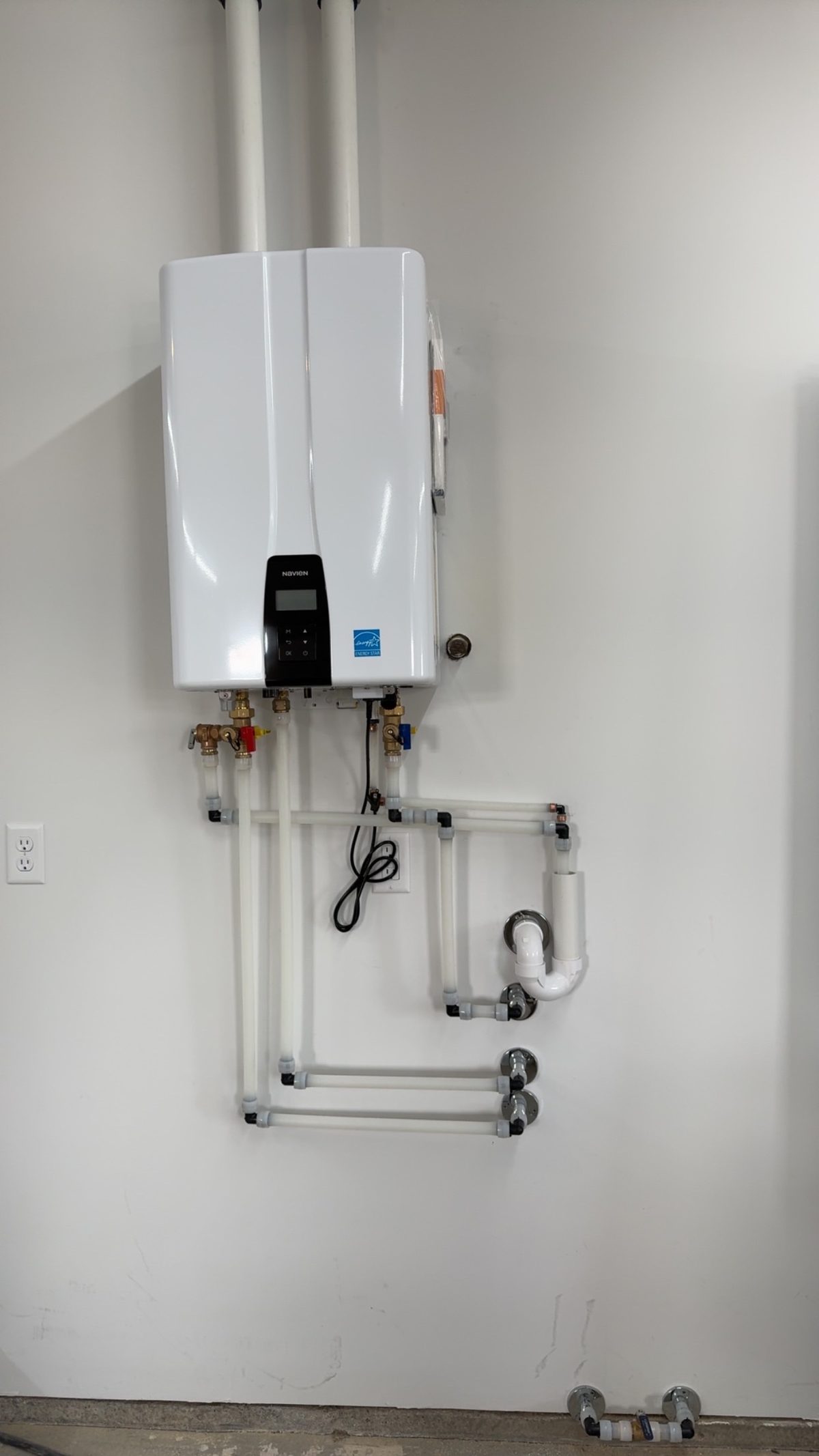
Clean PVC exhaust venting with CPVC water lines
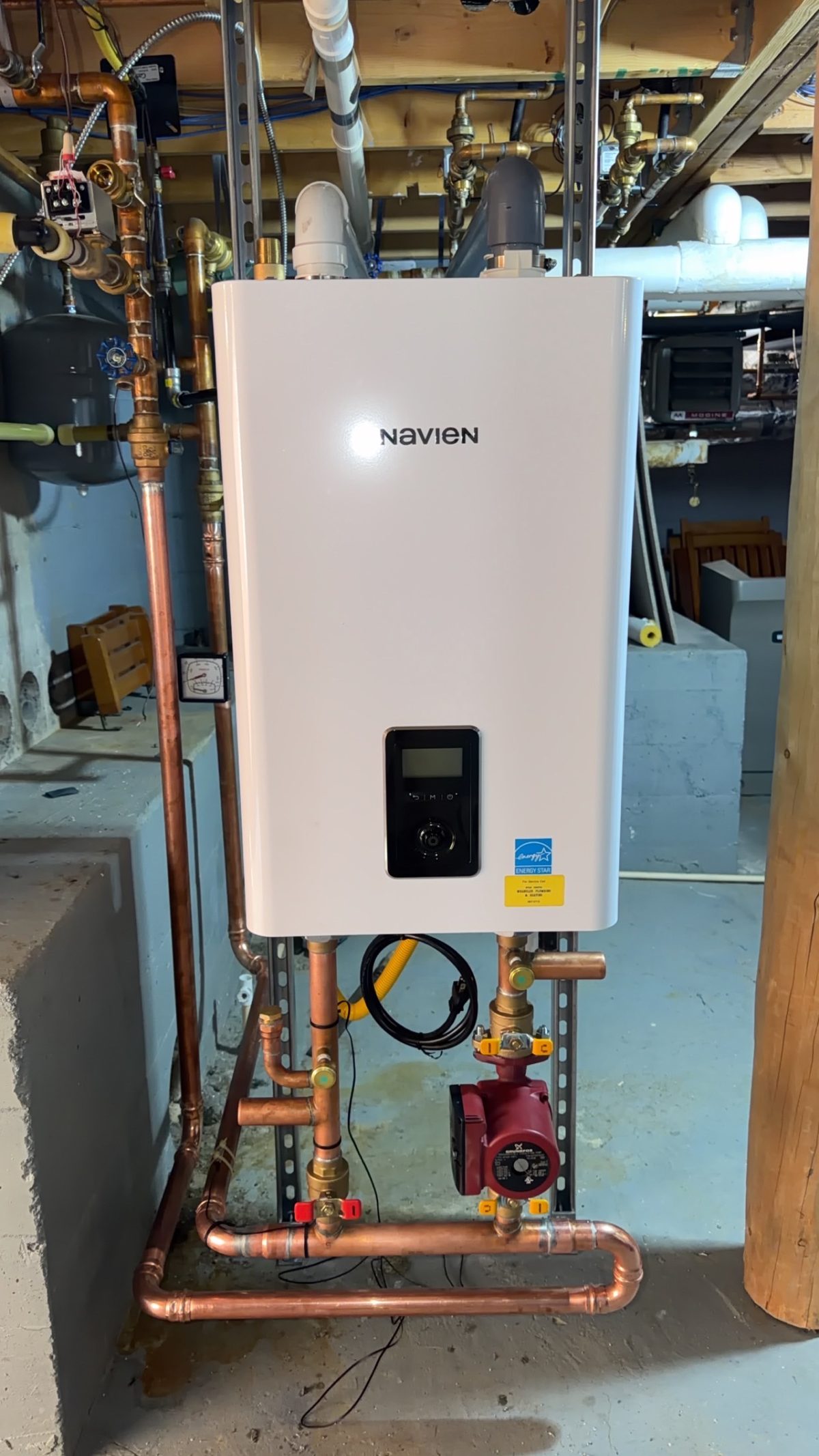
Navien with copper piping and expansion tank
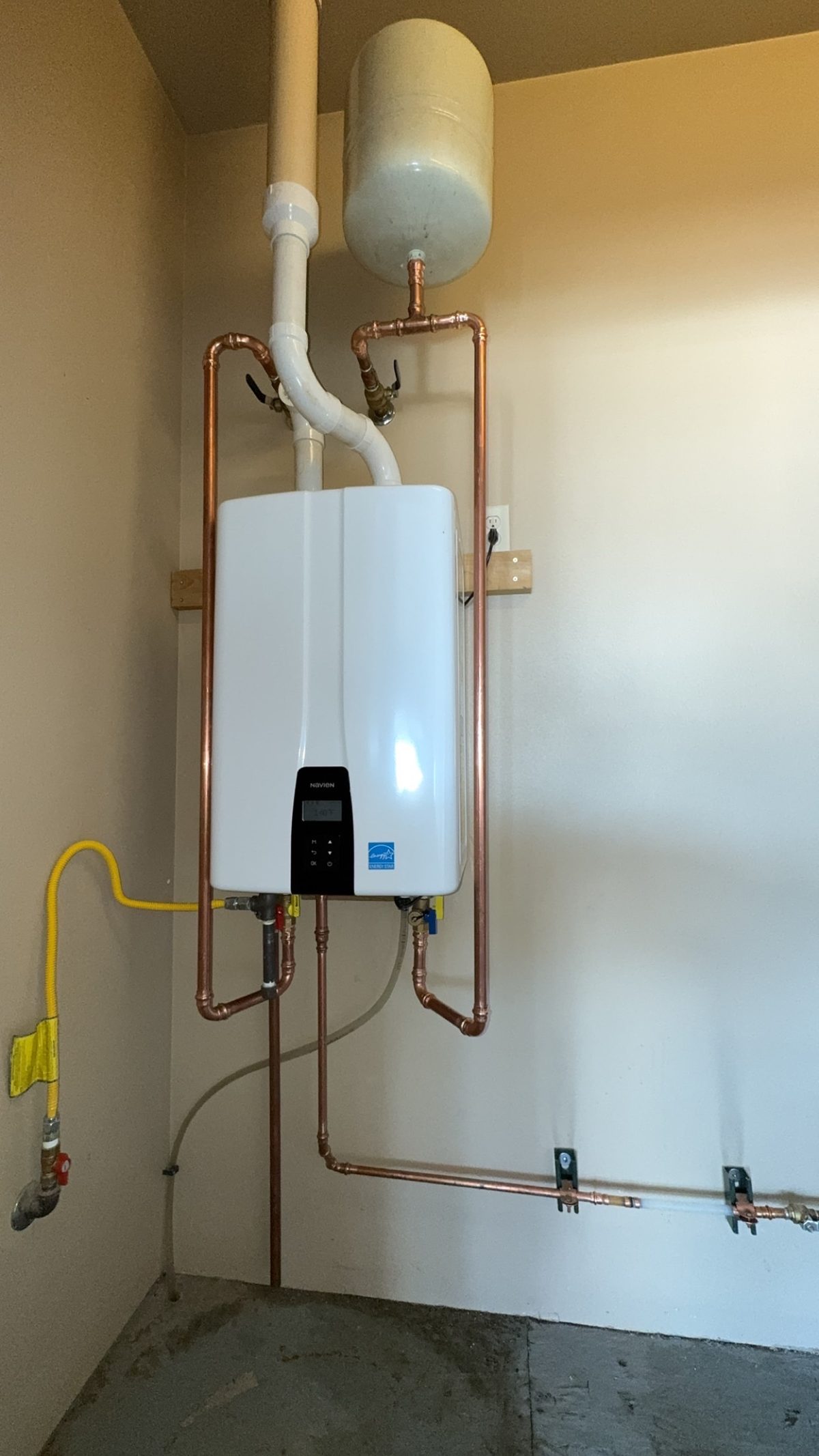
Proper thermal expansion protection for closed systems
Tankless Water Heater FAQs
A tankless water heater installation in Cody typically costs $3,000-$5,500 depending on the unit, gas line requirements, and venting. While the upfront cost is higher than a tank heater, tankless units last 15-20 years and save 20-30% on water heating costs, making them more economical over time.
Yes, but proper sizing is critical. Incoming water in Cody can be near freezing (35-40 degrees) in winter, meaning the unit must raise water temperature by 75-85 degrees. We size tankless units specifically for Wyoming's cold groundwater temperatures to ensure reliable hot water even on the coldest days.
We install Navien, Burnham, and A.O. Smith tankless water heaters. Navien is our most-installed brand due to their excellent cold-climate performance, built-in recirculation pumps, and industry-leading efficiency ratings. We match the brand and model to your home's specific needs.
Tankless water heaters should be descaled annually, especially in the Big Horn Basin where hard water is common. Mineral buildup reduces efficiency and can damage the heat exchanger. Annual descaling takes about an hour and costs significantly less than replacing a damaged heat exchanger.
For most Wyoming homes, gas tankless is the better choice. Gas units produce higher flow rates (8-11 GPM vs 2-5 GPM for electric), which is important when incoming water is near freezing. Electric tankless units work well for single-point applications like a bathroom or kitchen sink.
Yes, we retrofit tank-to-tankless conversions regularly. The process involves upgrading the gas line (tankless units require more BTUs), installing new venting, and mounting the unit. Most conversions are completed in one day. We assess your home's gas capacity and electrical requirements before recommending the switch.
Related Services
Water Heater Services
Complete water heater solutions including tank and tankless installation, repair, and maintenance.
Learn MoreWater Purification
Protect your tankless investment from hard water damage with a whole-home water treatment system.
Learn MoreGas Line Services
Gas line installation and upgrades for tankless water heaters and other gas appliances.
Learn More