
Water Heater Solutions for Wyoming Homes
Water heaters are one of the most important appliances in your home, but they're also one of the most neglected. Most homeowners don't think about their water heater until it fails unexpectedly on a cold winter morning. A failed water heater in January doesn't just mean cold showers—it can disrupt your entire family's routine and lead to emergency repair bills at the worst possible time.
The reality is that water heaters require proactive maintenance and planning. Whether you're facing an emergency breakdown or considering an upgrade, choosing the right system and getting professional installation matters tremendously for your home's comfort, energy bills, and long-term reliability.
At Wrangler Plumbing & Heating, we specialize in all aspects of residential water heater service:
- Emergency water heater repair and replacement (24/7 availability)
- Tank water heater installation (A.O. Smith, Heil, Champion brands)
- Tankless water heater installation (Navien, Burnham, A.O. Smith systems)
- Water heater maintenance and annual flushing services
- Pressure tank and gas line upgrades for tankless system conversions
- Honest repair vs. replace assessment and cost analysis
- Winterization and freeze prevention for Wyoming climates
- Water treatment system integration and coordination
With over 40 years of experience serving Wyoming's Big Horn Basin, we understand the unique challenges that our region's climate and water conditions pose to heating systems. We've successfully installed hundreds of water heaters in Cody, Powell, Lovell, Greybull, Basin, Worland, Thermopolis, Meeteetse, Byron, Clark, Shell, Burlington, and Ten Sleep. Our reputation for honest advice, fair pricing, and reliable work has earned us the trust of families across the Big Horn Basin since 1986.
Whether you need an emergency repair at 2 AM on a Sunday, want to compare tank versus tankless options, or need to replace an aging system before winter, our licensed plumbers will provide honest advice and fast, professional service. We primarily serve residential customers and light commercial properties. This focus means we understand your home's unique needs and can recommend solutions tailored to your family's size, usage patterns, and budget.
Tank vs. Tankless Water Heaters: Which Is Right for Your Home?
Choosing between a traditional tank and a modern tankless water heater is one of the most important decisions you'll make for your home's comfort and energy efficiency. This decision affects your monthly utility bills, how often you'll experience "running out" of hot water, your long-term maintenance requirements, and the total money you'll spend on water heating over the next 15-20 years. Both have distinct advantages and disadvantages, and the right choice depends on your household size, usage patterns, budget, and long-term plans for your home.
Many families assume one option is universally "better," but that's not accurate. A tankless system might be perfect for a retired couple with minimal hot water needs, while a large family with teenagers would struggle with the same unit. Understanding the genuine trade-offs helps you make a decision you won't regret.
| Feature | Tank Water Heater | Tankless Water Heater |
|---|---|---|
| Upfront Cost | $800-$1,500 | $2,000-$4,500 |
| Energy Efficiency | 60-80% efficient | 85-98% efficient |
| Annual Operating Cost | $400-$600/year | $200-$300/year |
| Lifespan | 8-12 years | 15-20 years |
| Space Required | 40-80 gallons stored | Compact, wall-mounted |
| Hot Water Supply | Limited by tank size | Unlimited on-demand |
| Flow Rate | Higher GPM for multiple uses | 2-5 GPM (lower flow) |
| Water Wait Time | Hot water already stored | 3-5 second delay |
| Maintenance | Annual flush required | Annual descaling needed |
| Repair/Replace Cost | Lower repairs | Higher repair costs |
| Wyoming Cold Water | Handles well | Requires more BTU |
| Hard Water Effects | Tank corrosion over time | Element scaling (regular flushing helps) |
Which Should You Choose?
Choose Tank if: You have a large family using lots of hot water simultaneously (multiple showers, laundry, dishwasher at same time), prefer lower upfront costs and simpler repairs, have limited money for capital investment, or want the most straightforward system to understand and maintain.
Choose Tankless if: You want maximum energy savings and can recoup the higher upfront cost through reduced utility bills, have limited physical space for equipment, have already planned a 15+ year stay in your home, can afford the initial investment, or you have a small household with modest simultaneous hot water needs.
Understanding the Real-World Trade-Offs
The comparison table shows the specs, but here's what these mean in your daily life:
Tank systems: You turn on a hot tap and get hot water immediately (or nearly immediately). You can run the shower, dishwasher, and laundry simultaneously without issue. During winter blizzards when power goes out, if you have a gas tank, you still have hot water (the pilot light doesn't need electricity). However, your utility bill will be higher because the system continuously heats and maintains 40-80 gallons whether you use them or not. You might run out of hot water during peak usage times if the tank is too small. The tank will eventually corrode and leak, typically around year 10-12.
Tankless systems: You turn on a hot tap and wait 3-5 seconds for hot water to arrive (the heating process needs time to ramp up). If multiple family members shower simultaneously or while someone runs the dishwasher, the system reaches its flow limit and you get lukewarm water instead of hot. Your utility bills are significantly lower because you're only heating water you actually use. The system works for 15-20 years if properly maintained. However, if the system fails, repairs are more expensive and more specialized plumbers are needed. During power outages, electric ignition tankless systems won't work at all (though modern units have some backup capabilities).
There's no objectively "right" choice—only the right choice for your specific situation, budget, and preferences.
Going Tankless: The Complete Guide for Wyoming Homes
Tankless water heaters (also called demand-type or instantaneous water heaters) have revolutionized how homeowners think about hot water. Instead of storing heated water in a tank, these systems heat water on-demand using powerful burners or electric elements. When you turn on a hot tap, cold water flows through a heat exchanger and emerges hot within seconds.
Why Tankless Works in Wyoming's Cold Climate
Wyoming's extremely cold inlet water temperatures (often below 40 degrees F in winter) present challenges for tankless systems. Incoming water must be heated 80-100 degrees F or more to reach comfortable shower temperatures. This requires high-capacity units with sufficient BTU output.
We recommend Navien tankless units for Wyoming specifically because they're designed to handle cold water efficiently. Navien systems feature advanced condensing technology and precise modulation, delivering consistent hot water even when inlet temps are frigid. Our customers report exceptional performance with Navien during brutal Wyoming winters.
Energy Savings & Payback Period
Tankless water heaters reduce heating costs by 24-34% compared to tank models because you're not continuously maintaining a large tank at set temperature. The typical payback period is 8-10 years, after which you're saving $300-$400 annually on energy bills alone. Federal tax credits of up to $1,000 may be available for qualifying units, further reducing your investment.
Sizing for Your Household
Tankless units are sized by flow rate (gallons per minute or GPM) needed for simultaneous use. A family needing hot water for a shower while washing dishes needs 5-7 GPM. We assess your household's needs and recommend the right-sized unit during a free consultation. Oversizing wastes money, while undersizing creates frustrating delays.
Navien, Burnham & A.O. Smith: Brand Comparison
Navien: Excellent for cold climates. Advanced inverter technology maintains consistent water temperature even at low flow rates. Great warranty support. Our preferred choice for Wyoming.
Burnham: Reliable engineering and proven performance. Good performance but slightly less ideal for extreme cold than Navien. Still excellent choice.
A.O. Smith: Solid performance and competitive pricing. Good warranty, handles cold water adequately for most Wyoming homes.
Installation Requirements
Tankless water heater installation is more complex than tank replacement. Your home may need:
- Upgraded gas line (if converting from electric tank or upgrading capacity)
- New venting system (typically PVC, requires proper pitch and condensate drain)
- Pressure tank or expansion tank (to protect system from pressure fluctuations)
- Gas permit and city inspection
- Certified installation ($2,000-$4,500 total depending on requirements)
These requirements mean tankless isn't always a simple swap for an old tank. We assess your plumbing during an in-home consultation and provide transparent pricing before work begins.
Traditional Tank Water Heaters: Reliable, Affordable, Proven
Don't let anyone tell you tank water heaters are obsolete. For many Wyoming families, especially those with multiple children or high simultaneous hot water needs, a traditional tank is the right choice.
We install and service three leading brands:
A.O. Smith
Premium American-made tanks with excellent corrosion resistance. A.O. Smith units tend to last longer than competitors, especially in hard water regions. Higher upfront cost but superior longevity makes them cost-effective long-term.
Heil
Reliable option with good energy efficiency ratings. Heil units perform well in Wyoming's cold climate and are readily available for parts and service. Good balance of affordability and durability.
Champion
Manufactured with a reputation for durability. Champion tanks are built tough for hard water and challenging climates. Excellent warranty support and locally-available parts. A popular choice among professionals for residential homes.
Maintenance Extends Tank Life
Most tank failures result from mineral buildup, not design flaws. In Wyoming's hard water environment, annual flushing removes sediment and extends tank life by 2-3 years. We offer affordable maintenance packages to keep your tank operating efficiently.
When Repair Makes Sense
If your tank is less than 8 years old and the repair costs under $300, repair usually makes sense. Once your tank reaches 10 years or shows signs of rust and scaling, replacement becomes the smarter investment. We provide honest assessments—sometimes we recommend keeping your old tank another year, even if it means deferring our sale.
Signs Your Water Heater Needs Attention
Age 10+ Years
If your water heater is older than 10 years, it's living on borrowed time. Manufacturing dates are on the label. Plan replacement before failure, especially before winter.
Leaking from Tank
Any water pooling around the base of your tank means failure is imminent. Don't wait—call immediately. Continued operation risks flooding and water damage.
Insufficient Hot Water
Running out of hot water in the middle of a shower, or needing extended heating time, indicates sediment buildup or heating element failure. We can often fix this with flushing or element replacement.
Loud Noises
Rumbling, popping, or knocking sounds mean mineral deposits are cracking inside the tank. This indicates accelerated deterioration. Flushing may help temporarily, but replacement will likely be needed soon.
Discolored Water
Rust-colored or cloudy hot water suggests tank corrosion. Some types of discoloration indicate sediment only (fixable with flushing), while others mean the tank itself is compromised.
Frequent Repairs
If your water heater requires repairs more than once per year, replacement is usually more economical than continued patching. We calculate the math with you before recommending replacement.
Wyoming-Specific Considerations: Why Your Water Heater Faces Unique Challenges
Wyoming's geography and climate create special demands on water heating systems that homeowners in milder climates never encounter. Understanding these factors helps you make informed decisions about equipment selection and maintenance.
Extremely Hard Water
The Big Horn Basin has some of the hardest water in America (250-400+ parts per million of dissolved minerals). This mineral-heavy water accelerates corrosion of tank interiors, clogs heating elements, and creates sediment buildup.
What we recommend: Annual flushing for tanks, annual descaling for tankless, and consideration of a whole-home water treatment system.
Cold Inlet Water Temperatures
Wyoming's groundwater is extremely cold—often 35-40 degrees F year-round. To reach comfortable shower temperature (104-108 degrees F), your system must add 65-75 degrees F of heat. This requires more energy and stresses equipment harder than in warmer climates.
What we recommend: Proper-sized tankless units with high BTU output, or larger-capacity tank units.
High Altitude Effects
Cody sits at 5,050 feet elevation. Thinner air reduces oxygen availability for combustion, affects gas pressure, and can make venting systems work less efficiently.
What we recommend: Professional sizing and installation accounting for altitude, proper venting design, and equipment selected for high-altitude performance.
Winter Power Outages & Freezing Risk
Wyoming winter storms cause extended power outages and below-zero temperatures. Electric water heaters become useless during outages, while gas units remain functional (with proper venting).
What we recommend: Gas-powered systems for reliability in winter, proper pipe insulation, and winterization service before October.
Higher Heating Costs
Energy costs run 30-40% higher in Wyoming than national averages. This makes energy efficiency especially important. Over a system's 10-year lifespan, energy savings from upgrading to a high-efficiency unit can exceed the installation cost.
What we recommend: Prioritize efficiency. A tankless unit costing $1,000 more upfront can save $3,000+ in energy costs over 10 years.
Well Water & Radiant Floor Systems
Many Big Horn Basin homes use well water with minerals and sediment, and some have radiant floor heating that requires specific water heater types and careful system integration.
What we recommend: Let us assess your well water quality and heating system before recommending equipment.
Water Heater Maintenance: Extend Your System's Life
Regular maintenance is the single best investment for extending water heater lifespan and maintaining efficiency. We recommend annual service, especially in Wyoming's hard water environment.
Tank Water Heater Maintenance
Annual Flushing: Sediment accumulation from hard water is the #1 cause of premature tank failure. Annual flushing removes these deposits, improving efficiency and extending tank life by 2-3 years. We perform this service for $150-$200.
Anode Rod Inspection: The anode rod corrodes instead of the tank, protecting against rust. We inspect it annually and replace when necessary ($100-$150). Replacing a failing anode rod before it's completely gone can add years to your tank's life.
Temperature & Pressure Valve Test: This safety device must function properly. We test it annually to ensure it releases pressure if temperatures or pressures become dangerous. Replacement is $75-$150 if needed.
Tankless Water Heater Maintenance
Annual Descaling: Hard water minerals accumulate on tankless heating elements, reducing efficiency and eventually causing failure. We descale your unit annually using food-grade citric acid solution. Cost: $150-$250.
Water Filter Replacement: Many tankless systems include inlet filters to protect the heat exchanger. We replace these filters annually (cost: $30-$60) to prevent element damage and maintain flow rate.
Professional Inspection: We inspect gas connections, venting system, pressure tank integrity, and all electrical components. Early detection of issues prevents expensive emergency repairs during winter. Annual inspection: $100-$150.
Annual Maintenance Package: We offer customers an annual water heater maintenance package for $199-$299 depending on system type, including flushing/descaling, filter replacement, valve testing, and professional inspection. This typically saves money versus emergency repairs and extends system lifespan significantly.
Real Water Heater Installations in Cody & the Big Horn Basin
Every photo below is from an actual Wrangler Plumbing job — not stock photography. See the quality of our tankless water heater installations firsthand.
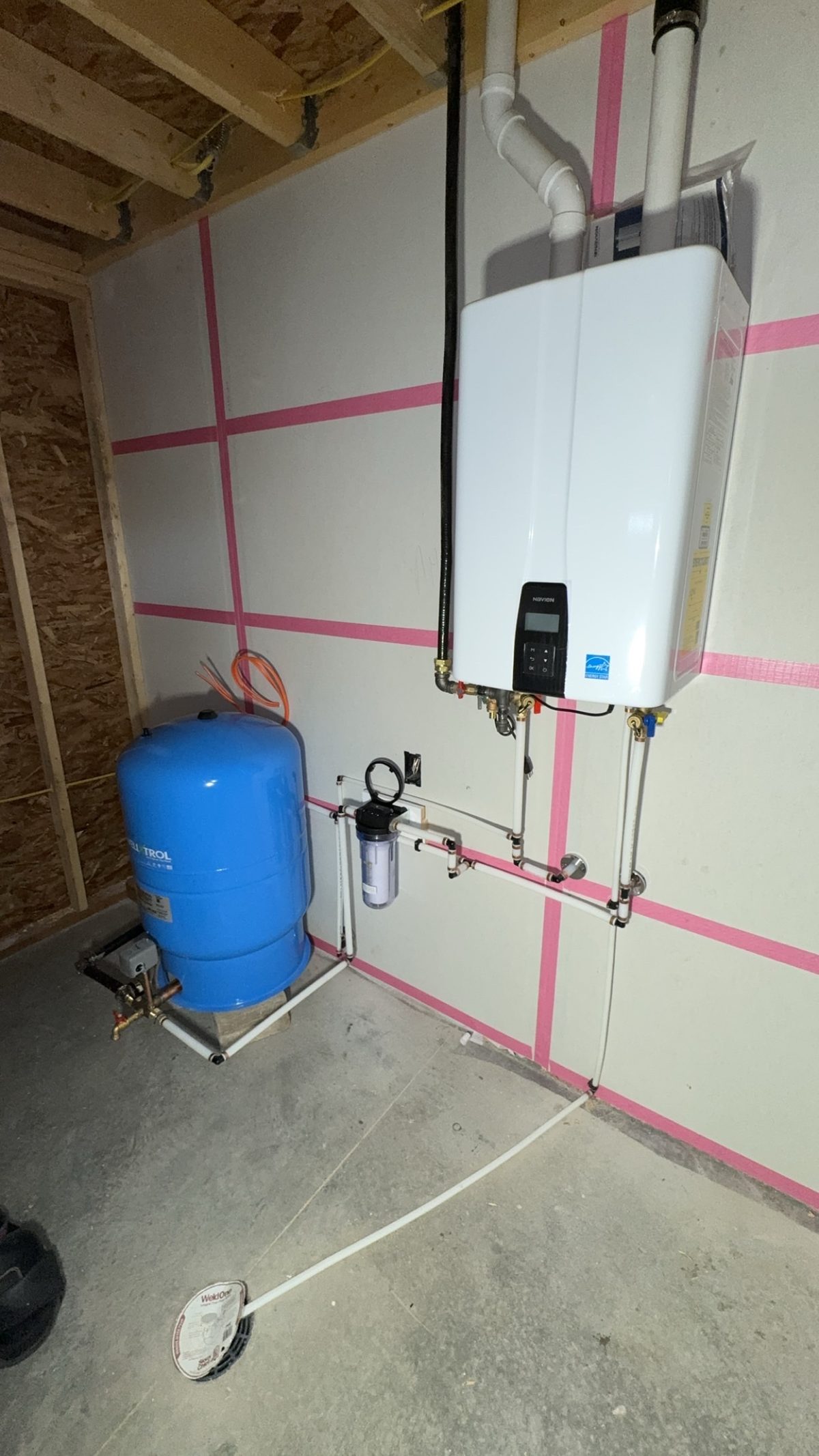
Navien tankless with Well-X-Trol pressure tank and inline water filter
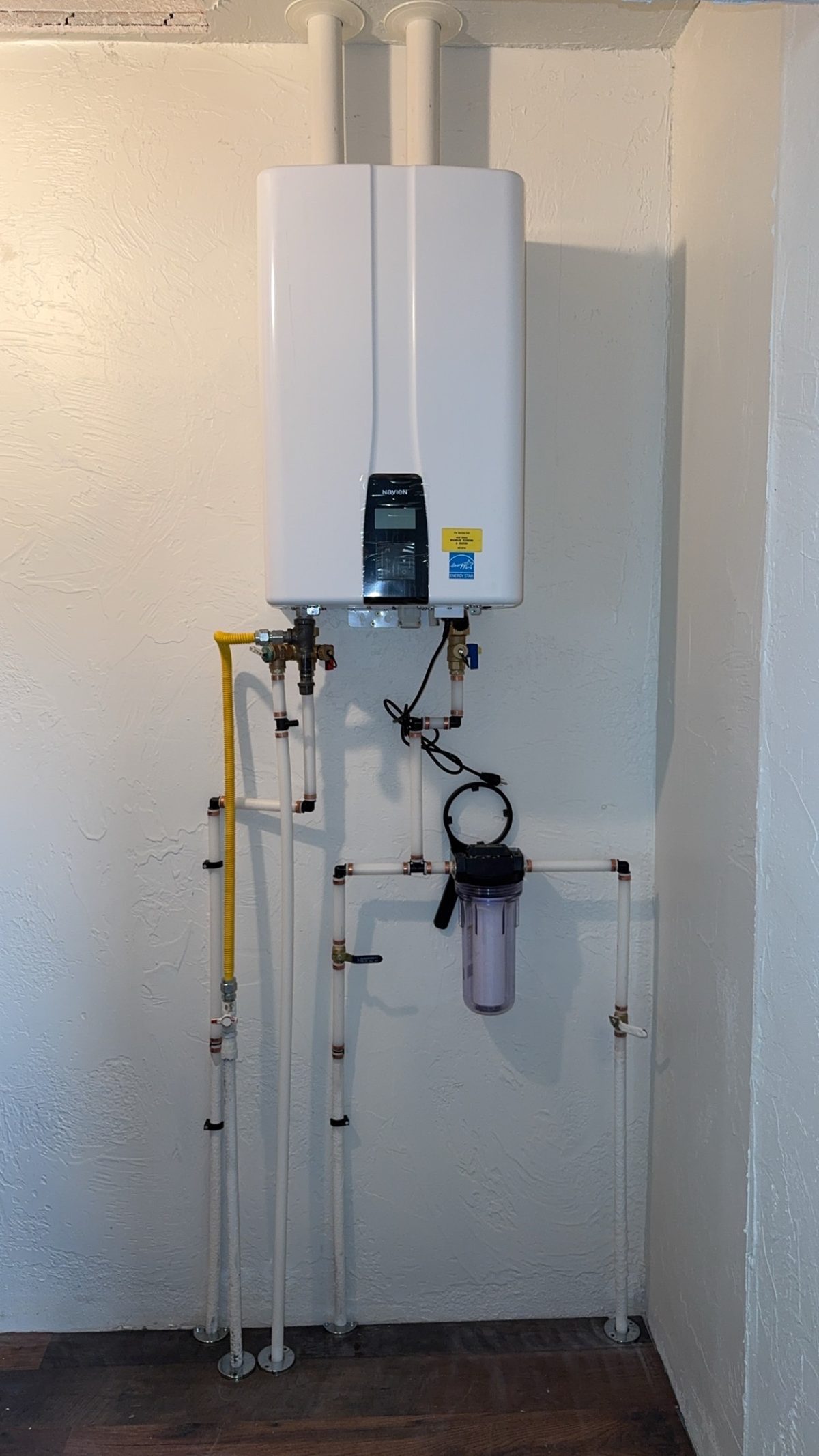
Navien with yellow gas flex connector and inline filtration system
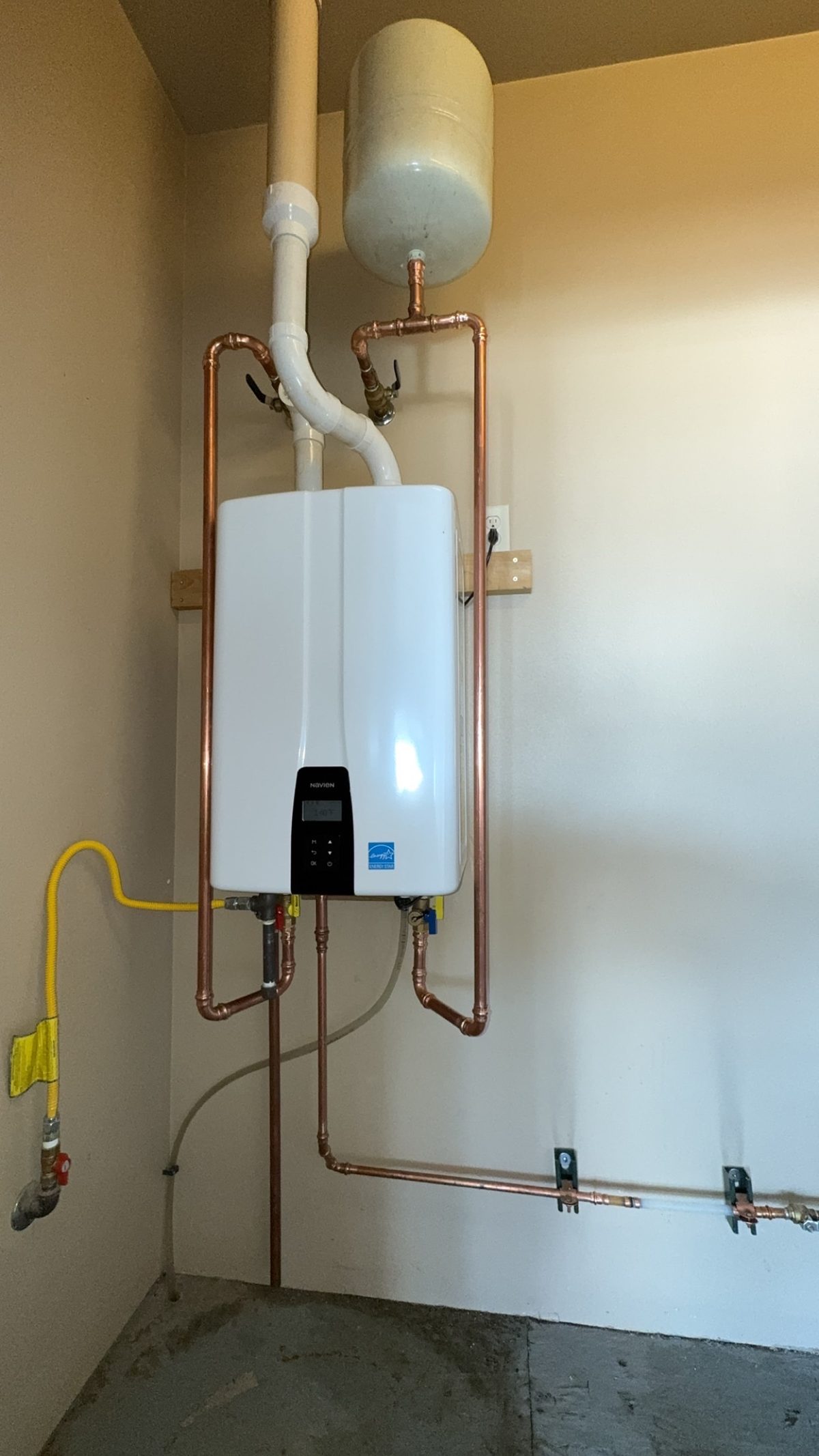
Navien tankless with copper supply lines, expansion tank, and yellow gas flex
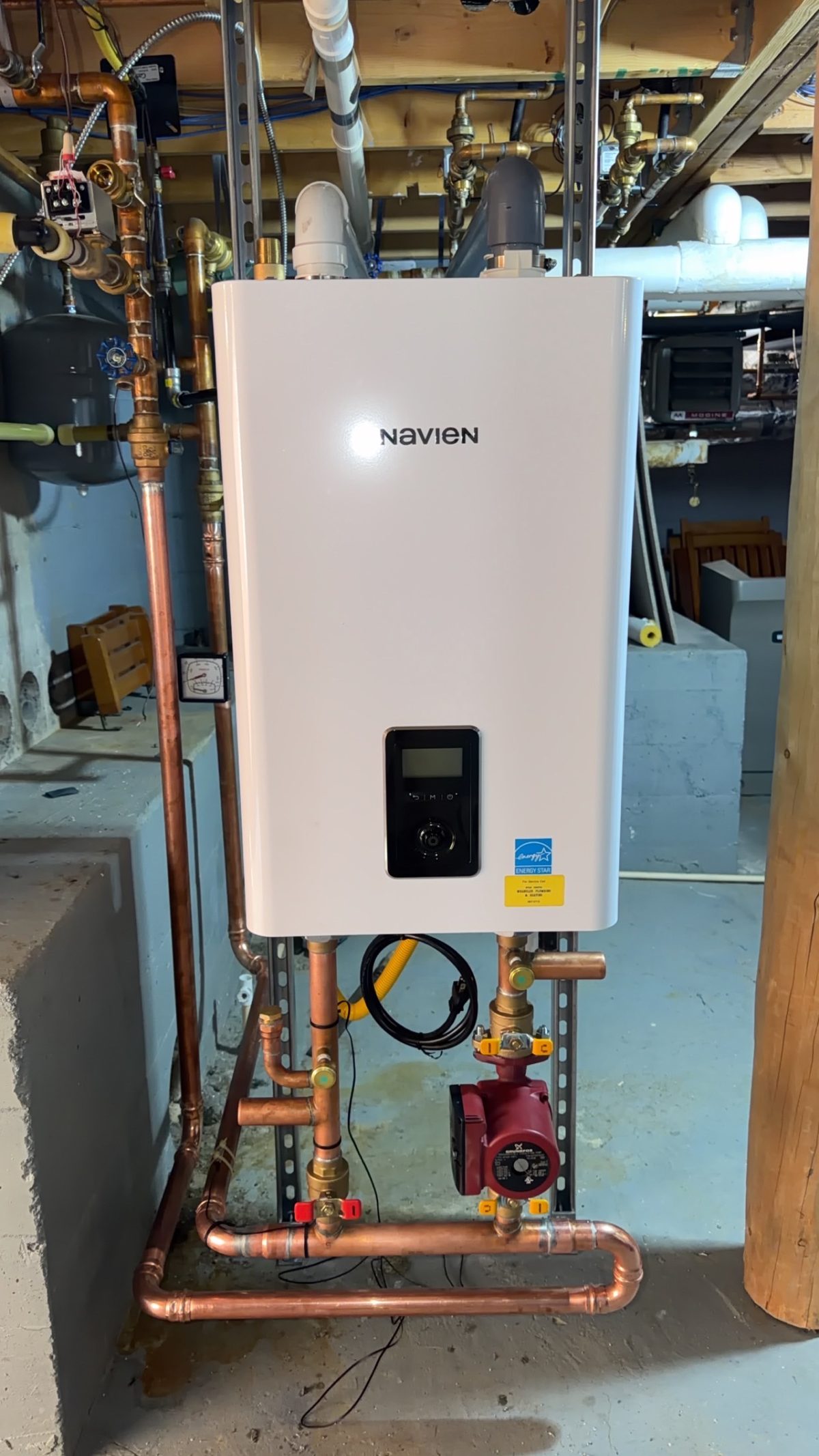
Navien in older home basement with copper piping and Grundfos circulation pump
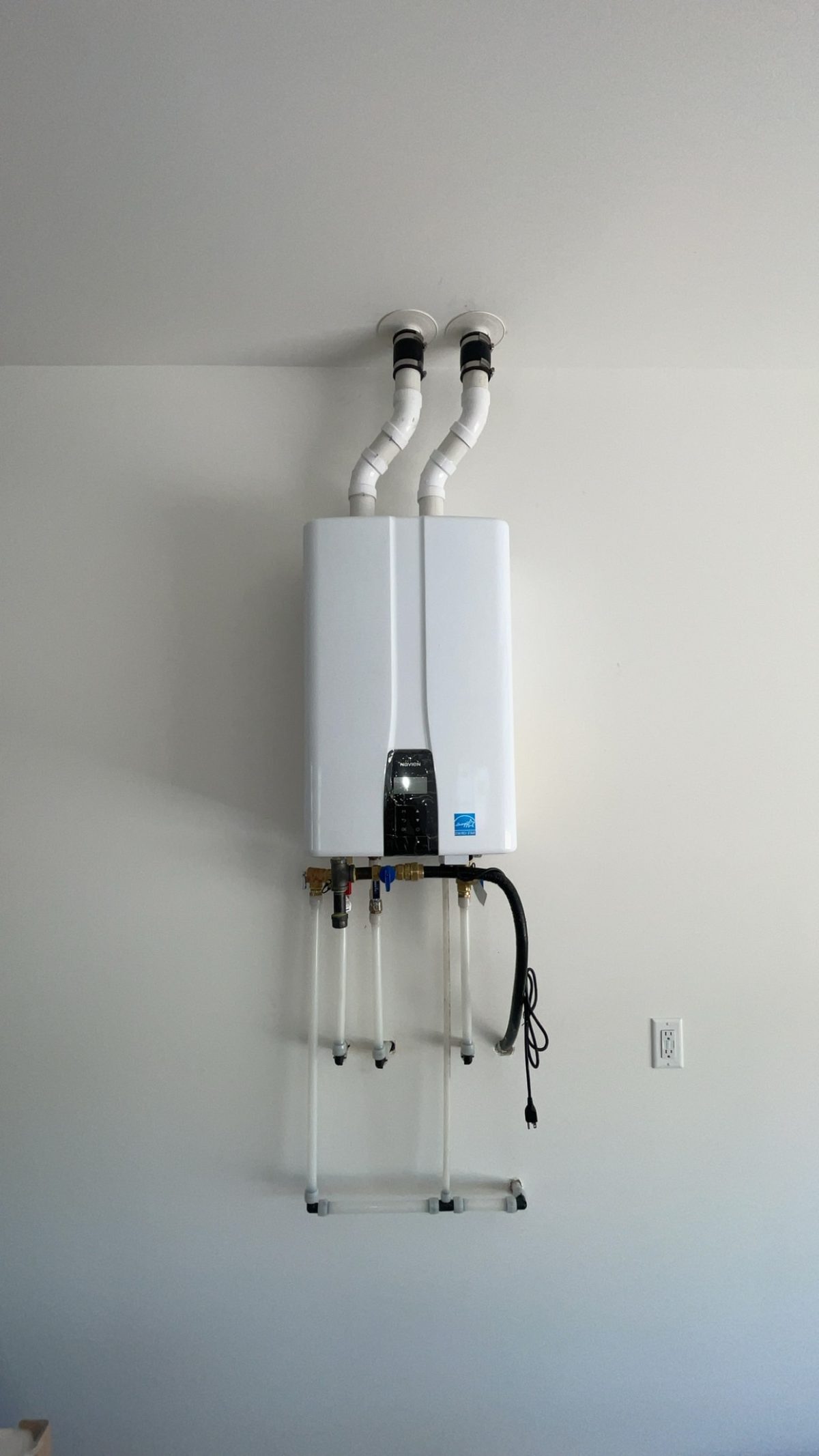
Navien with dual PVC exhaust venting — clean, code-compliant installation
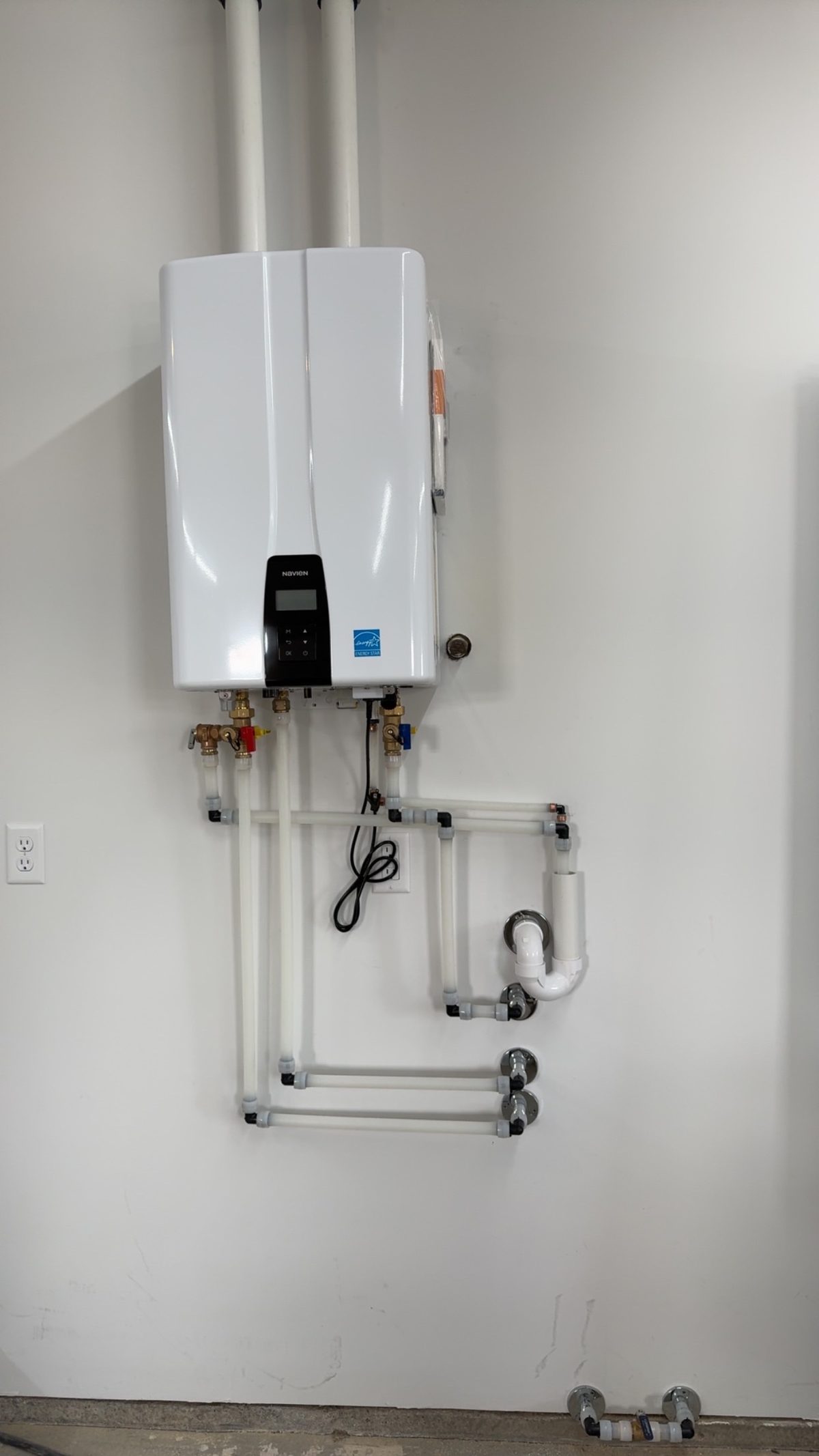
Navien with CPVC water lines, PVC venting, and condensate P-trap drain
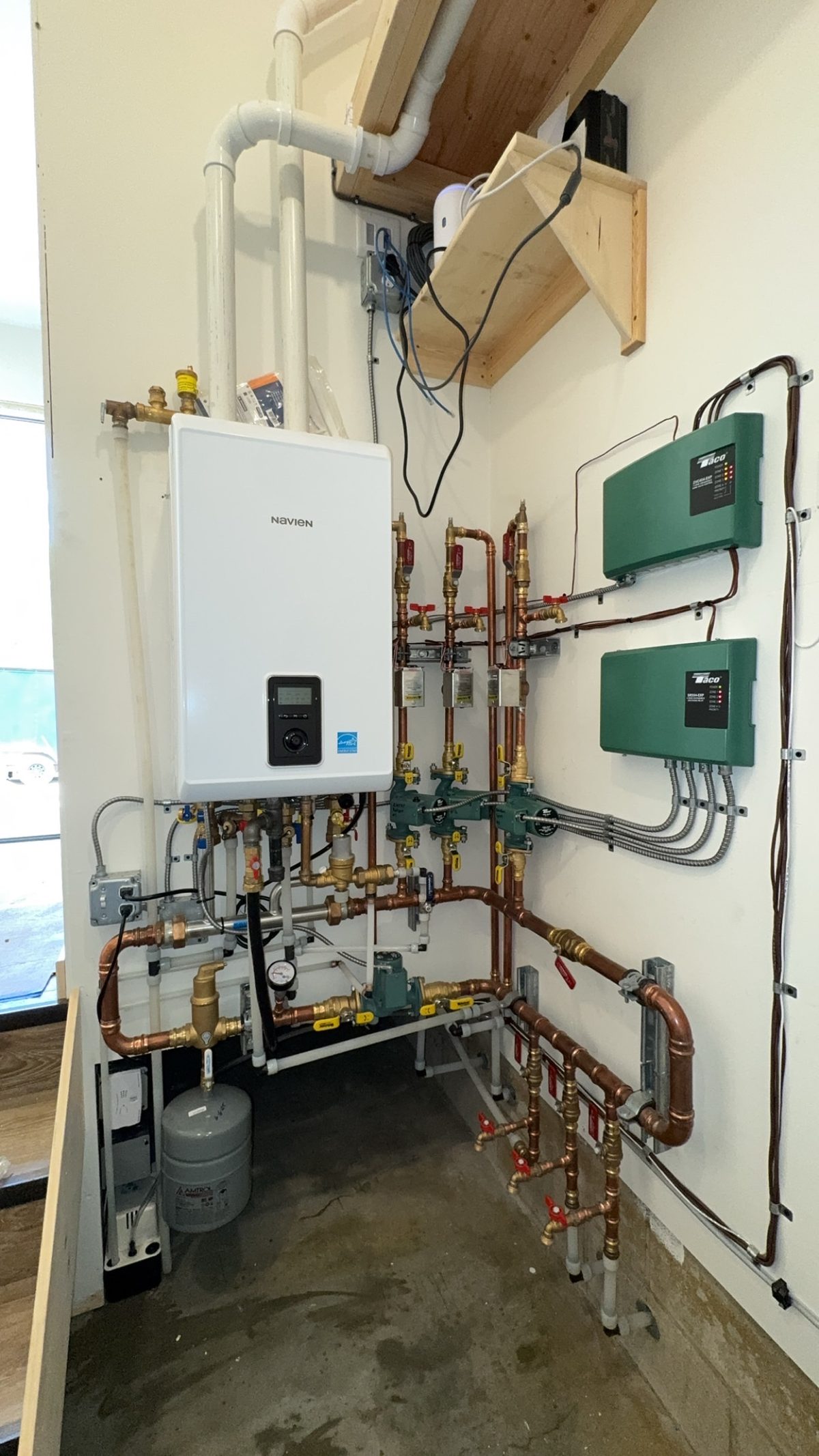
Navien boiler with dual Taco zone controllers, copper manifold, and expansion tank
Frequently Asked Questions About Water Heaters
Tank water heaters store 40-80 gallons of hot water in an insulated tank, providing consistent hot water for multiple simultaneous uses. Tankless water heaters heat water on-demand without storage, saving energy and providing unlimited hot water but at slower flow rates and with higher upfront costs. Tank heaters typically cost $800-$1,500 installed, while tankless units cost $2,000-$4,500 installed.
Traditional tank water heaters typically last 8-12 years before needing replacement. Tankless water heaters can last 15-20 years with proper maintenance. The lifespan depends on water quality, maintenance frequency, and usage patterns. Hard water and heavy use reduce lifespan. Wrangler Plumbing recommends replacing tank water heaters showing signs of corrosion, rust, or leaking once they reach 10 years of age.
If your water heater is less than 8 years old and the repair cost is under $500, repair usually makes sense. If it's older than 10 years, actively leaking from the tank, or requiring multiple repairs annually, replacement is more cost-effective long-term. A new energy-efficient unit will also lower your utility bills. We provide free estimates to help you decide. Call (307) 587-3713.
We install and service Navien tankless water heaters, A.O. Smith tank heaters, Heil, and Champion units. We also handle other major brands on a case-by-case basis. Navien is our preferred tankless brand due to excellent reliability and warranty support in Wyoming's cold-climate conditions.
Tank water heater installation typically costs $800-$1,500 including the unit, labor, and basic venting. Tankless installation ranges $2,000-$4,500 due to gas line and venting upgrades often required. Cost varies based on your existing plumbing configuration, venting type, and location within our service area. We provide free estimates with no obligation.
Wyoming's extremely hard water, cold inlet temperatures, and altitude put extra stress on water heating systems. Hard water minerals corrode tank interiors and damage heating elements. Cold incoming water requires more energy to heat. We recommend descaling tankless units annually and flushing tank units every 2 years. Adding a water treatment system significantly extends water heater life.
Yes. Wrangler Plumbing & Heating provides 24/7 emergency water heater service. If you lose hot water unexpectedly, call (307) 587-3713 anytime day or night, weekends, and holidays. We respond quickly to Cody and throughout the Big Horn Basin. Emergency service may carry an additional fee.
Yes. Federal tax credits are available for certain Energy Star-certified tankless and high-efficiency tank water heaters. Wyoming also offers some state energy incentives. Additionally, tankless water heaters reduce heating costs by 24-34% compared to tank models. Our team can discuss which units qualify for rebates and estimate your long-term energy savings.